





Transmembrane Lipid Translocation (Flip-Flop)
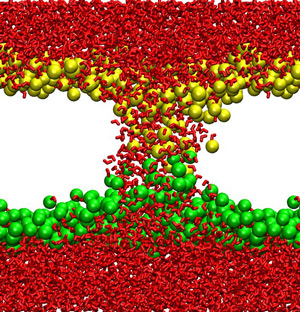
As asymmetric transmembrane lipid distribution is vital for living cells, cellular membranes have special mechanisms to maintain the lipid asymmetry by means of translocation (flip-flop) of lipid molecules from one membrane leaflet to another. One way cells make this happen is to employ active transport of lipids across a lipid bilayer using specific membrane proteins, flippases. To complement the active translocation, cells also use passive transport mechanisms with the help of proteins or without them. We employ atomic-scale MD simulations to shed some light on molecular mechanism associated with lipid flip-flops in protein-free membranes which are exceptionally poorly understood. In particular, it has been established that the passive lipid flip-flop is a pore-mediated process: the appearance of a transient pore in the membrane (induced either by a transmembrane ion density gradient or by a chemical means) inevitably leads to diffusive translocation of lipids through the pore.
Other projects: