







Cation-Mediated Interactions of DNA with Phospholipids
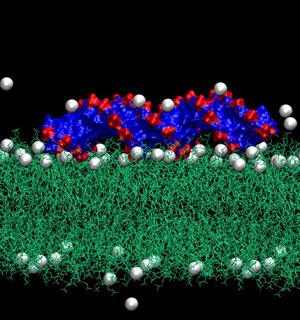
Liposome-based gene delivery vehicles normally involve synthetic cationic lipids. However, the use of cationic species is known to be accompanied by cytotoxicity so that replacing cationic lipids with zwitterionic ones has recently attracted a great deal of attention: Zwitterionic phospholipids, being natural components of cellular membranes, are completely nontoxic. In contrast to cationic lipid systems, anionic DNA molecules do not adsorb spontaneously on electrically neutral, zwitterionic phospholipid membranes. Many experimental studies have repeatedly demonstrated that DNA-zwitterionic lipid association can be triggered by divalent cations such as calcium ions. However, the underlying molecular mechanism of the DNA-phospholipid interactions remains largely unknown. To address this problem, our simulation studies focus on atomic-scale details of adsorption of DNA on zwitterionic phospholipid membranes under the presence of divalent cations.
Other projects: